
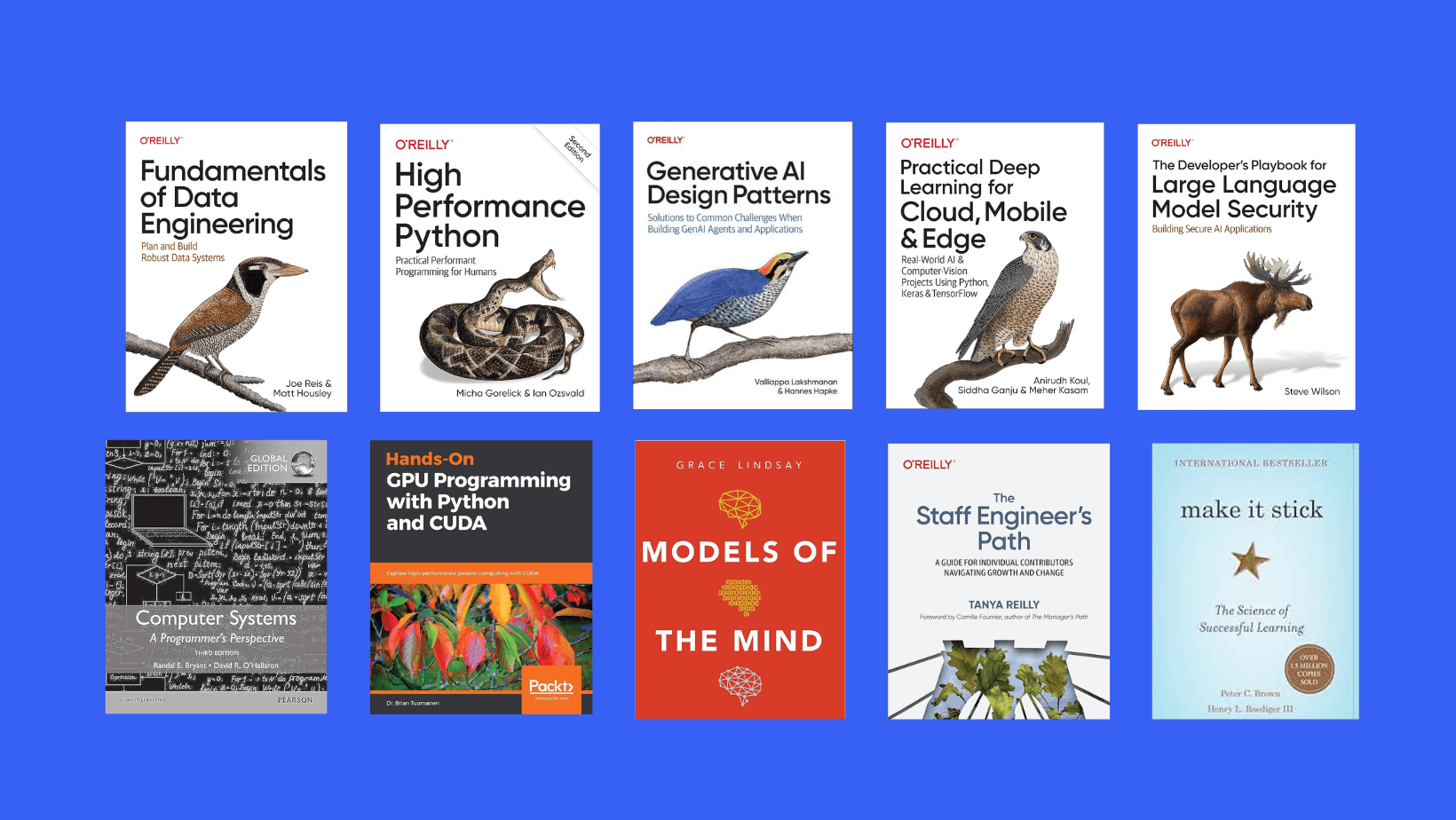
Reading books when Artificial Intelligence is growing this fast may seem impossible. Every month new models are released, Agentic systems govern workflows, and Autonomous AI, reasoning models, and AI-powered organizations are becoming more sophisticated, so an AI engineer might become overwhelmed and decide to take shortcuts and avoid sitting down and reading books patiently. However, no matter how fast AI evolves, an AI engineer needs to build deep understanding and surprisingly it is simpler when we know which books are essential and can shorten the learning time if they are chosen strategically. Great books help you understand foundational ideas that shape the future of AI. In this article, we introduce 10 great books for 2026 that help AI engineers strengthen their understanding of AI engineering, machine learning, data engineering, and modern AI systems This reading list covers some of the most important areas of modern AI engineering, including computer systems, data engineering, performance optimization, generative AI, AI security, technical leadership, and effective learning.
Co-Intelligence by Ethan Mollick
The Coming Wave by Mustafa Suleyman
AI Engineering by Chip Huyen
The Worlds I See by Fei-Fei Li
Supremacy by Parmy Olson
Nexus by Yuval Noah Harari
The Singularity Is Nearer by Ray Kurzweil
The Alignment Problem by Brian Christian
Human Compatible by Stuart Russell
Life 3.0 by Max Tegmark
One of the most practical books for the AI era.
Co-Intelligence is one of the most useful books for AI engineers. The main focus in this book is not only on future predictions, but it is about effective collaboration between AI and people in everyday work.
Key themes are:
Human-AI collaboration
Productivity enhancement
Knowledge work transformation
Organizational adoption of AI
This book is indeed valuable for Senior AI engineers who are curious about the impact of AI on their careers and workflows.
Highly recommended to: Managers, knowledge workers, consultants, and entrepreneurs.
This book is written by the co-founder of DeepMind and founder of Inflection AI, and it focuses on how powerful technologies can change our society.
Topics include:
Artificial Intelligence
Synthetic Biology
Global governance
Technological containment challenges
Suleyman’s main argument is that people will experience an era where technological capabilities are evolving fast, making adaptation challenging for institutions, governments, and societies.
Best for: Leaders, policymakers, and technology strategists.
Since rapid evolution of AI is overwhelming for organisations, they have realised they need to shift to production deployment; this has made AI Engineering the main discipline.
This book covers:
Building AI applications
Model deployment
Production systems
AI infrastructure
Real-world implementation challenges
This book does not focus only on model training, it is about how AI systems are indeed delivered to users.
Best for: AI engineers, ML engineers, and software developers.
This book combines her own journey with the history of modern AI.
The author, Fei-Fei Li, is one of the well-known AI researchers in the world. She explains her challenges in the creation of ImageNet; interestingly, creating a dataset that helped AI engineers to accelerate deep learning.
Readers will understand:
Computer vision
Deep learning breakthroughs
AI research culture
Human-centered AI
Recommended to: Anyone interested in the history and human side of AI.
This book gives insight into the competition between leading AI organizations and the leaders who shaped the AI revolution. It focuses on how companies such as OpenAI and DeepMind have emerged and also the growing race for AI leadership. .
Key topics:
AI industry competition
OpenAI vs DeepMind
Power dynamics in technology
The future of AI governance
Best for: Founders, investors, and technology enthusiasts.
Harari’s argument focuses on the impact of information networks on human civilization and the influence of AI on those networks.
The book triggers curiosity about:
Information systems
Collective intelligence
Power structures
The future of human decision-making
Nexus prioritizes exploring the societal and historical perspectives of AI in addition to its technological aspects.
Best for: Readers interested in the broader implications of AI.
A follow-up to his influential predictions about technological acceleration.
Kurzweil discusses:
Exponential technological growth
Artificial General Intelligence (AGI)
Human enhancement
Future human-machine integration
Whether readers agree with his predictions or not, the book remains one of the most influential perspectives on long-term AI development.
Best for: Those who are enthusiastic for future of technology
The alignment problem is one of the most important books for understanding AI safety.
The book argues a critical challenge:
How do we ensure AI systems follow the real goals of people?
Themes include:
AI alignment
Reinforcement learning
Bias in AI systems
Ethical decision-making
The more autonomous AI systems become, the more important alignment is.
Best for: AI practitioners, researchers, and policymakers.
Stuart Russell’s argues that the traditional approach to AI development is becoming limited. In the future, AI systems should seek adaptations and learning from human preferences, not focusing on building machines to optimize fixed objectives.
The book covers:
AI safety
Control problems
Human-centered intelligence
Long-term AI governance
Best for: for those who have passion about responsible AI development.
Life 3.0 gives insight into how artificial intelligence transform the future of:
Work
Education
Economics
Politics
Scientific discovery
The book describes numbers of scenarios for how AI could reform civilization in the future decades.
Best for: Anyone who is curious about AI's long-term impact.
You need to keep in mind that reading all books at once could be frustrating. It is recommended to categorize them into three.
A more effective approach is to divide them into three groups:
For Technical Skills
AI Engineering
Co-Intelligence
The Worlds I See
For AI Strategy and Business
The Coming Wave
Supremacy
Nexus
For AI Safety and the Future
Human Compatible
The Alignment Problem
Life 3.0
The Singularity Is Nearer
Using this structure assist AI engineers to build practical knowledge in addition to strategic understanding.
Final Thoughts
The fast pace of AI could be distressing, but deep learning takes time. Books help us to shape foundational ideas and show us that we need to take our time and grasp important insights rather than stressfully chasing the trends.
The professionals will take the lead that do not only count on the latest models but they understand;
How AI systems work
How organizations adopt AI
How AI impacts society
What risks and opportunities lie ahead
These 10 books provide insight into the technical knowledge, strategic thinking, historical context, and future vision.
If you're serious about building a career in AI, leading AI initiatives, or understanding the future of technology, this reading list is an excellent place to start.